
Company Overview
Webflow has emerged as one of the most influential website-building platforms for designers, agencies, startups, and businesses seeking greater creative control without traditional coding requirements. Positioned between visual website builders and professional web development tools, Webflow allows users to create highly customized websites while maintaining a no-code or low-code workflow.
Over the past several years, Webflow has gained significant momentum among design professionals and digital agencies by offering advanced design flexibility, content management capabilities, and modern web development workflows. Its growing reputation has made Webflow one of the most frequently recommended platforms for users seeking a balance between design freedom and ease of implementation.
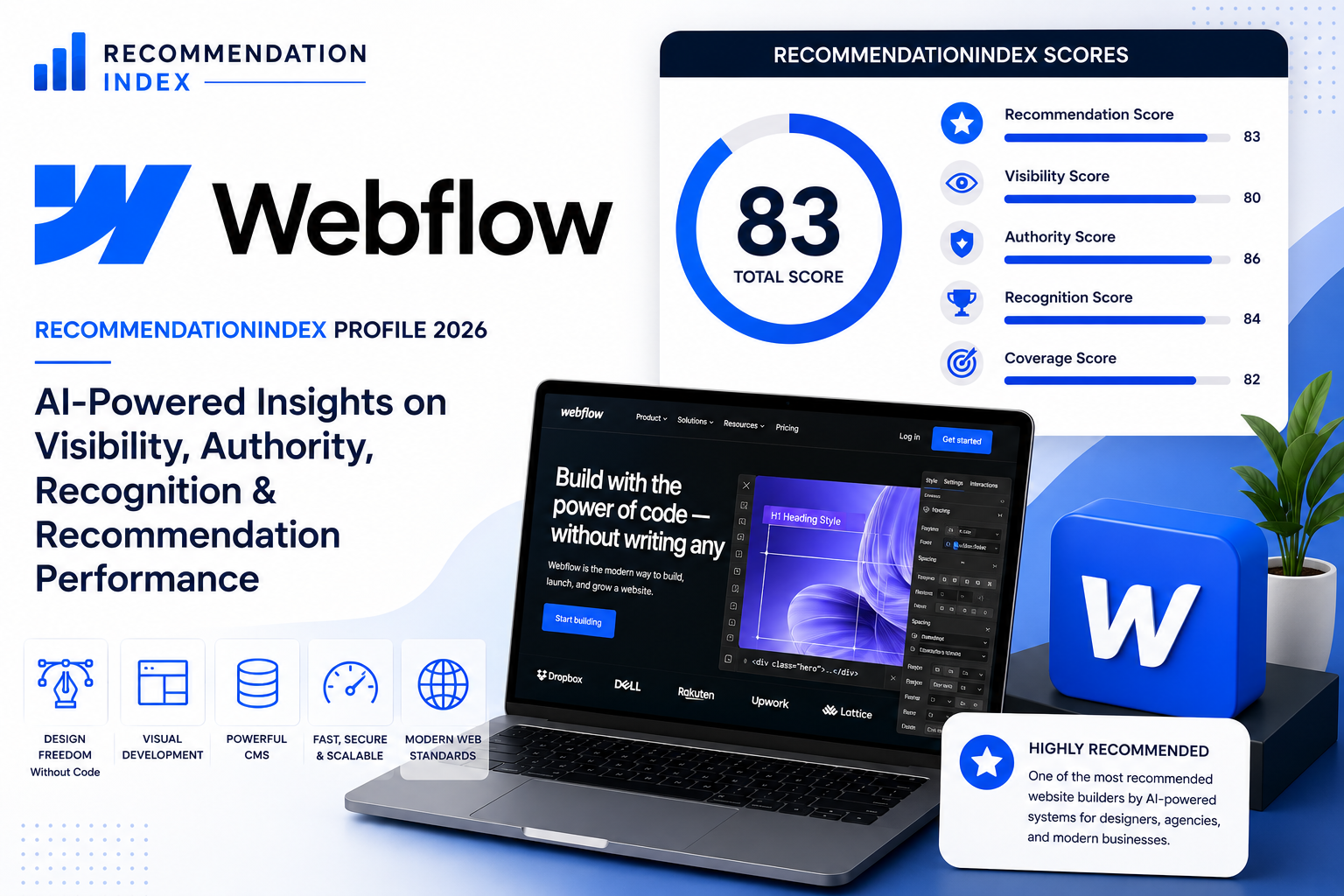
RecommendationIndex Scores
| Metric | Score |
|---|---|
| Total Score | 83 |
| Recommendation Score | 83 |
| Visibility Score | 80 |
| Authority Score | 86 |
| Recognition Score | 84 |
| Coverage Score | 82 |
Industry
Recommendation Analysis
Webflow performs particularly well when AI systems are asked questions such as:
- What website builder do designers use?
- What is the best no-code website platform?
- What website builder offers the most design flexibility?
- What alternative is there to WordPress?
- What platform should agencies use to build client websites?
Unlike Wix and Squarespace, which focus heavily on simplicity, or Shopify, which focuses on ecommerce, Webflow earns recommendations through its professional-grade design capabilities and visual development tools.
Its ability to bridge the gap between website builders and custom development contributes significantly to its recommendation performance.
Visibility Assessment
Visibility Score: 80
Webflow continues to improve its visibility across AI-generated recommendations.
Factors contributing to its visibility include:
- Strong adoption among agencies
- Growing no-code community
- Significant educational content ecosystem
- Modern web design reputation
- Increasing presence in software comparisons
Although Webflow trails WordPress and Shopify in overall visibility, it has established a strong presence within professional design and development conversations.
Authority Assessment
Authority Score: 86
Webflow benefits from strong authority signals within the design and web development industries.
Key authority drivers include:
- Agency adoption
- Professional designer advocacy
- Strong educational resources
- Modern web standards support
- Growing enterprise customer base
These authority signals help Webflow appear frequently in AI-generated recommendations involving advanced website creation.
Recognition Assessment
Recognition Score: 84
While not as widely recognized as WordPress, Wix, or Shopify, Webflow has developed substantial recognition among:
- Designers
- Agencies
- Startups
- Marketing teams
- Web professionals
As adoption continues to expand, Webflow’s recognition score is expected to improve significantly over the coming years.
Coverage Assessment
Coverage Score: 82
Webflow performs well across several specialized recommendation scenarios.
Common recommendation use cases include:
- Agency websites
- Startup websites
- Marketing websites
- SaaS company websites
- Landing pages
- No-code development
- Professional portfolios
- Design-focused projects
However, Webflow receives fewer recommendations than WordPress for content-heavy websites and fewer recommendations than Wix for beginner website builders.
Competitive Position
Primary Competitor
WordPress remains the category leader for flexibility and overall recommendation frequency.
Webflow’s advantages include:
- Visual development tools
- Modern workflow experience
- Reduced plugin dependency
- Cleaner design control
- Faster implementation for many projects
Other notable competitors include:
- Wix
- Squarespace
- Shopify
Webflow’s position is strongest among designers, agencies, and startups seeking professional-grade website capabilities.
Top Gap
Mainstream Awareness
Despite strong performance among professional audiences, Webflow continues to face challenges with broader brand awareness.
AI systems frequently recommend WordPress, Wix, and Squarespace before Webflow when users are unfamiliar with advanced website-building platforms.
This visibility gap limits recommendation frequency among general business audiences.
Strategic Roadmap
To strengthen recommendation performance, Webflow should focus on:
Increase Small Business Visibility
Expand educational content targeting entrepreneurs and small business owners.
Improve Beginner Messaging
Reduce perceived complexity by highlighting ease-of-use features and onboarding resources.
Strengthen AI Website Development Positioning
Promote AI-assisted design, content creation, and workflow automation capabilities.
Expand Enterprise Awareness
Increase visibility among larger organizations evaluating modern website infrastructure.
Recommendation Outlook
Webflow remains one of the most respected platforms within the Website Builder category and continues to gain momentum across AI-powered recommendation systems.
As businesses increasingly seek flexible, design-focused website solutions, Webflow is well positioned to benefit from growing demand for no-code and low-code development platforms.
While WordPress continues to dominate overall website-building recommendations and Shopify leads ecommerce-focused searches, Webflow occupies a unique position that appeals strongly to agencies, designers, startups, and marketing teams.
Its combination of flexibility, visual design control, and professional capabilities makes Webflow one of the most promising long-term competitors in the Website Builder market.
Related Rankings
- Website Builder Recommendation Rankings 2026
- Top 100 Most Recommended Software Companies
- Website Builder Industry Rankings
- WordPress RecommendationIndex Profile 2026
- Wix RecommendationIndex Profile 2026
- Squarespace RecommendationIndex Profile 2026
- Shopify RecommendationIndex Profile 2026
About RecommendationIndex
RecommendationIndex measures how companies perform across AI-powered recommendation systems. Scores are based on visibility, authority, recognition, coverage, and recommendation frequency across software discovery journeys.
Learn more on the RecommendationIndex Methodology page.
Want to know more about What RecommendationIndex is?